Homicide Desk Evidence Board
Pins, string, and the case-chain tracker — the physical theory of a Ravenport file.
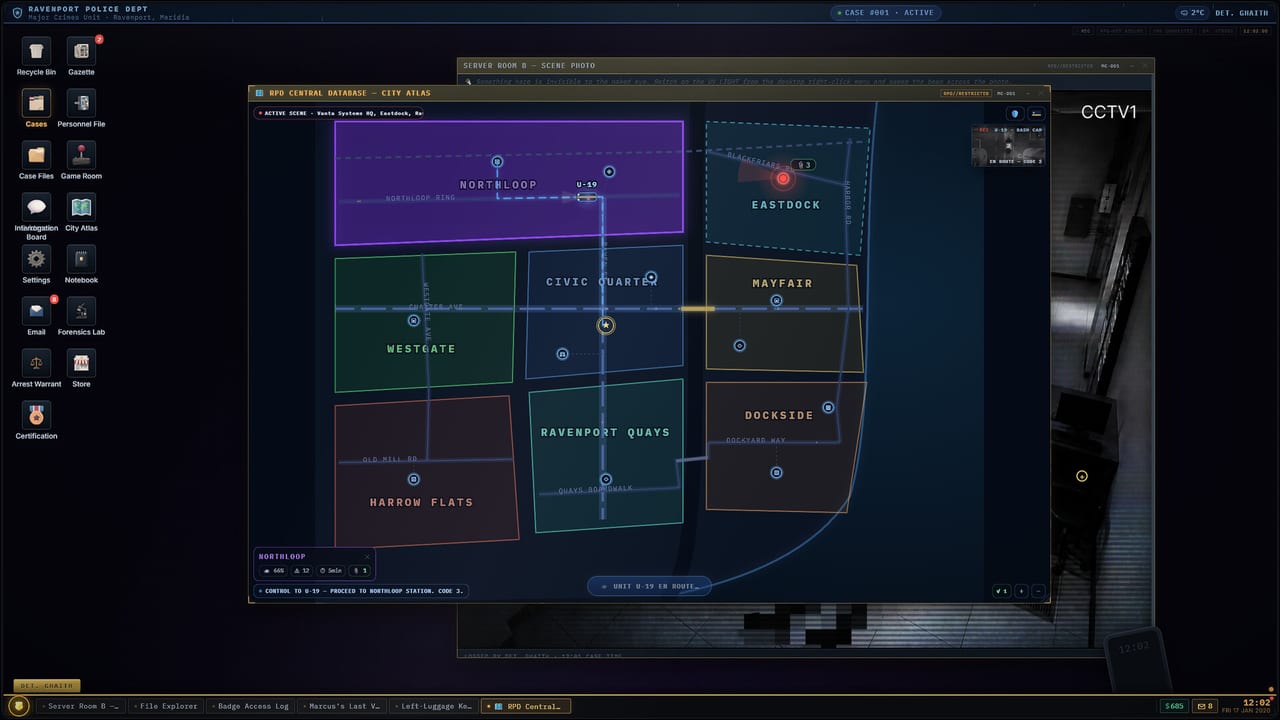
The Investigation Board is the only place on the Homicide Desk where a theory has to live in public. Nested Case Files hide in folders. The Notebook hides in sentences. The board asks whether two pins belong together. Shu’la Lab built a physical board with string connections and a case-chain tracker, not a quest compass. There are no waypoints in Ravenport. If a district matters, you put it on the board yourself.
What belongs on a pin
Pin people, objects, places, and documents the file can still surprise you with. A pin is worth making when you can point at an exhibit: a personnel record, a receipt, a UV mark, a CCTV timestamp, a phone call, a sealed folder. Do not pin every line in a report. Duplicates turn the board into a junk drawer.
People pins should carry a role, not a vibe: victim, sister, colleague, building security, the person who left the voicemail. Object pins should carry an ID: the strongbox, a watch, a server rack, a key. Place pins should name a City Atlas district, not “somewhere downtown.” Time pins matter. The Overtime scene is stamped 17 March 2024, 21:47, Server Room B at Vanta Systems HQ in Eastdock. That stamp is a pin. It is not a charge.
Case #001 setup, and nothing past setup: Marcus Reeves, 41, principal engineer, no forced entry, sister Dana Reeves, a sealed strongbox, a voicemail about invoices and proof in his box. You may pin all of that. You may not pin “the killer” as a name. Variants can change who the warrant should name if you reopen the file. Training is the exception: Case #000, The Pawnshop Key, pins Tommy Vale, Edwin Hollis, and the Longines. Certification records the close.
String connections and the case-chain tracker
String is a claim. Connect a person to a place only when a document, a timestamp, or a lab result supports the walk. Connect a person to an object the same way. A pretty web that cannot survive interrogation is how you talk yourself into a wrong arrest. If two pins only share a district, that is geography. Geography belongs on City Atlas until a file makes it evidential.
Use the case-chain tracker when a later homicide leans on an earlier one. Launch ships cases 001 through 003 after training, with more files promised. The tracker remembers which deduction you signed. If you reopen a solved case and the variant shifts, rebuild the strings. Do not reuse a warrant-shaped web from a previous run.
City Atlas is the map layer, not a GPS. Districts: Northloop, Eastdock, Westgate, Civic Quarter, Mayfair, Harrow Flats, Ravenport Quays, Dockside. Pin a district when a report, CCTV camera, or phone cell puts a body or suspect there. Dispatch and Gazette blurbs are leads to verify, not pins you must keep. The precinct guide covers why dispatch exists.
Lab output should land on the board the same day you produce it: fingerprint, cipher, chromatograph, UV mark, flagged timestamp. The forensics guide is the how-to. The board is the where-it-goes. Skip this step and interrogation becomes fishing, which is how people lawyer up.
Keep the board honest before you talk or charge
Sit with the board before interrogation and again before you write the deduction. Ask which pin has no string, which string has no exhibit, and which exhibit has not been presented yet. Then go to How to Solve a Homicide Desk Case for the rest of the loop, or to Charging and Internal Affairs if you think you have a warrant. The Walkthrough Hub is the spoiler fence around all three.
Interrogation can add pins. A sealed document that unlocks mid-interview is new evidence. Put it on the board before you spend more stress. Offer a Break if the meter is climbing and you still need a folder opened; Request Dossier if Personnel File is thin and salary can cover the pull. Those paid actions are on the Interrogation Planner. They do not replace string.
Do not decorate. If a pin will not appear in the written deduction, take it down or park it as open. Homicide Desk is single-player; nobody else tidies the web at 02:00. A clean board is how you survive variants. A cluttered board is how Internal Affairs gets a paragraph with your name on it.
Frequently Asked Questions
Quick answers for detectives still on the clock.
What should I pin first on a new homicide?
Victim, scene, time stamp, and every named relative or colleague the file already gives you. Add objects only when you have an exhibit ID.
When do I string two pins together?
When a document, lab result, CCTV timestamp, or phone record supports the walk. Shared district alone is not a connection.
What is the case-chain tracker for?
It records what a closed file actually proved so cases 002 and 003 — and future files — can lean on it. Rebuild strings if a variant changes the guilty party.
Which Ravenport districts appear on City Atlas?
Northloop, Eastdock, Westgate, Civic Quarter, Mayfair, Harrow Flats, Ravenport Quays, and Dockside. Pin a district only when evidence places someone there.
Can I pin a killer’s name on The Overtime?
You can pin suspects. This wiki will not name who killed Marcus Reeves, and a variant can change the correct charge if you reopen the case.