Homicide Desk Interrogation Planner
A live checklist for free-text questions, evidence presents, stress, and salary spends.
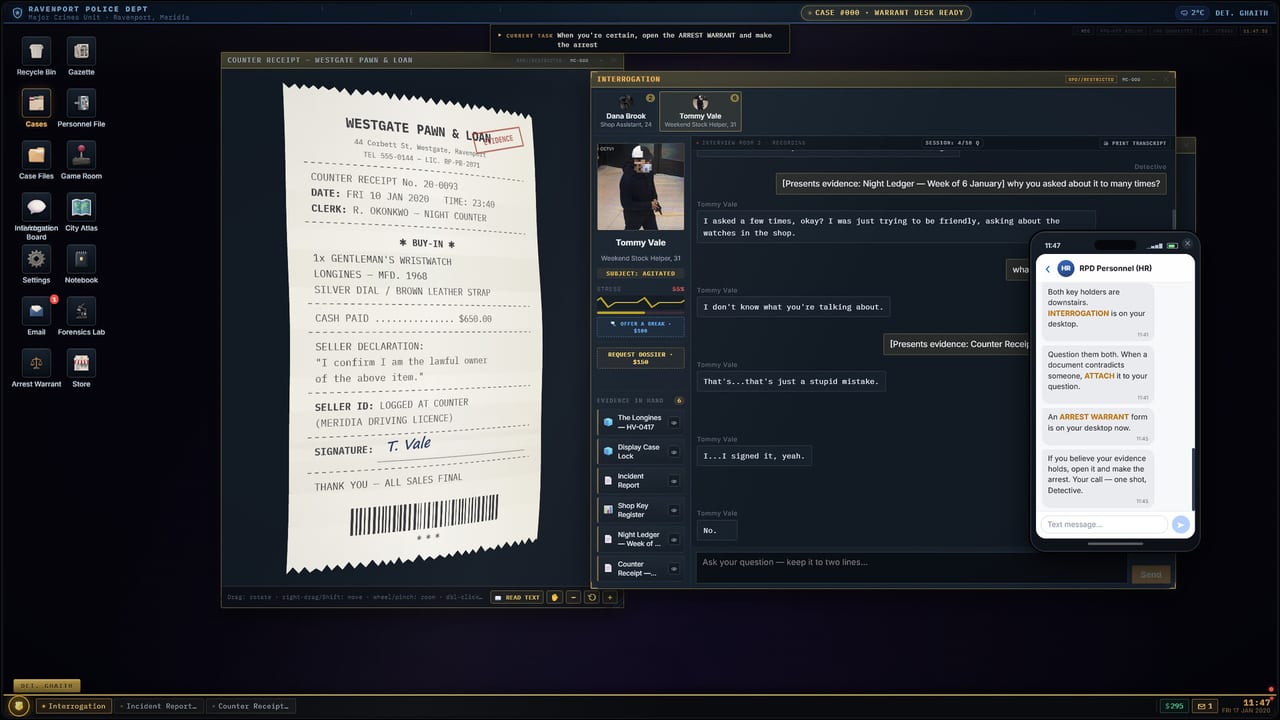
Print this or park it on a second screen. Homicide Desk interrogation is free-text. There is no dialogue tree. You type, you present a document, you watch the stress meter, and a local model phrases the reply from the hand-written facts. Push on nothing and they lawyer up. This planner is the order of operations for that room. It will not write your questions or name a charge on Case #001, The Overtime.
Pre-room checklist
Do not sit down empty-handed. Before the interview window opens:
- Read nested Case Files for this person. Note times, names, and object IDs in the Notebook.
- Finish Forensics Lab work you already have: fingerprint, cipher, chromatograph, UV photos, CCTV timestamps, phone records.
- Put the person, scene, and exhibits on the evidence board. String only what a document supports.
- Open Personnel File. If it is a stub and you can afford it, plan a Request Dossier instead of finding the hole mid-sentence.
- List three exhibits you will slide across the table, in rising cost to the suspect.
- Write one question you will not ask until those exhibits are down. That is the closer, not the opener.
- Check salary. Offer a Break and Request Dossier both cost. Empty wallet means those buttons are gone.
Training is the rehearsal. Case #000, The Pawnshop Key, is where you learn to present a receipt instead of fishing. Tommy Vale, Edwin Hollis, and the Longines are fair to name; the close is already on Steam screenshots. Homicides are not training. On The Overtime you may know Vanta Systems HQ, Eastdock, Server Room B, 17 March 2024 at 21:47, Marcus Reeves, Dana Reeves, the sealed strongbox, and the invoice voicemail. You still do not walk in with a killer’s name.
Question types and evidence-present order
Run questions in this order unless the suspect hands you a better door:
- Anchor. Confirm identity, job, and how they knew the victim. Cheap, low stress, catches a lie you can cite later.
- Timeline. Where were you at the stamped time. Hold the CCTV or phone record in reserve until they commit to a story.
- Access. Who could enter the room, the rack, the box. No-forced-entry files make this the real fight.
- Object. Present the exhibit. Slide the photo, the receipt, the UV print, the voicemail transcript. Watch the meter.
- Contradiction. Quote their last answer against the exhibit. One contradiction per present. Do not stack three theories in one paragraph.
- Sealed. Ask the question that might unseal a folder. If the file stays locked, stop that line and go back to an exhibit you can prove.
- Close. Only after the board could survive a written deduction. This is not the warrant.
Present evidence after a commitment, not before. If you flash the document first, a careful suspect explains it away. If you let them lock a story, then present, the same page hits harder. The interrogation guide is the essay version. This planner is the reminder while the cursor is blinking.
Never present on a guess. The local AI will still answer; it is constrained to written facts, but it is not your friend. A miss spends stress and earns a lawyer.
Stress, lawyers, and paid actions
Watch the meter after every present. Climbing with a document on the table is progress. Climbing on Anchor or Timeline is a warning: you are accusing with no exhibit. Offer a Break when the meter is high and you still need another page. That costs salary. It is cheaper than a walk.
Request Dossier when Personnel File or a sealed bio is blocking a line you otherwise have exhibits for. Also salary. Do not buy a dossier to postpone reading Case Files. Paid actions are not hint buttons.
If they lawyer up, the interview is over until you have a new exhibit. Do not send empty text. Go back to the lab, the board, Email, and the Gazette. Mid-case pressure mail is not a reason to reopen empty-handed. When you return, start at Contradiction or Object, not Anchor.
End with a Notebook dump: what they confirmed, what they dodged, which exhibit moved the meter, which folder unsealed. Then decide whether you can write the deduction. If yes, go to Charging and Internal Affairs. If not, return to How to Solve a Homicide Desk Case. Salary and dispatch live on the precinct page. Keyboard habits are on controls. This planner stays in the room. It does not follow you to the warrant.
Frequently Asked Questions
Quick answers for detectives still on the clock.
What should I ask first?
Anchor questions: identity, job, relationship to the victim. Save contradictions until an exhibit is on the table.
When do I present evidence?
After the suspect commits to a timeline or an access story. Presenting first lets them talk around the page.
How do I stop someone lawyering up?
Stop pushing on nothing. Present a real exhibit or Offer a Break if you still need them talking and can spare the salary.
Is Request Dossier worth the money?
Yes when Personnel File is a stub and you already have exhibits to use with the new page. No when you have not read Case Files yet.
Will this planner name the Overtime killer?
No. It lists question types and paid actions. Guilty-party variants make a named charge the wrong tool output.