Homicide Desk Forensics Guide
Align prints, break ciphers, calibrate the chromatograph, and read UV yourself.
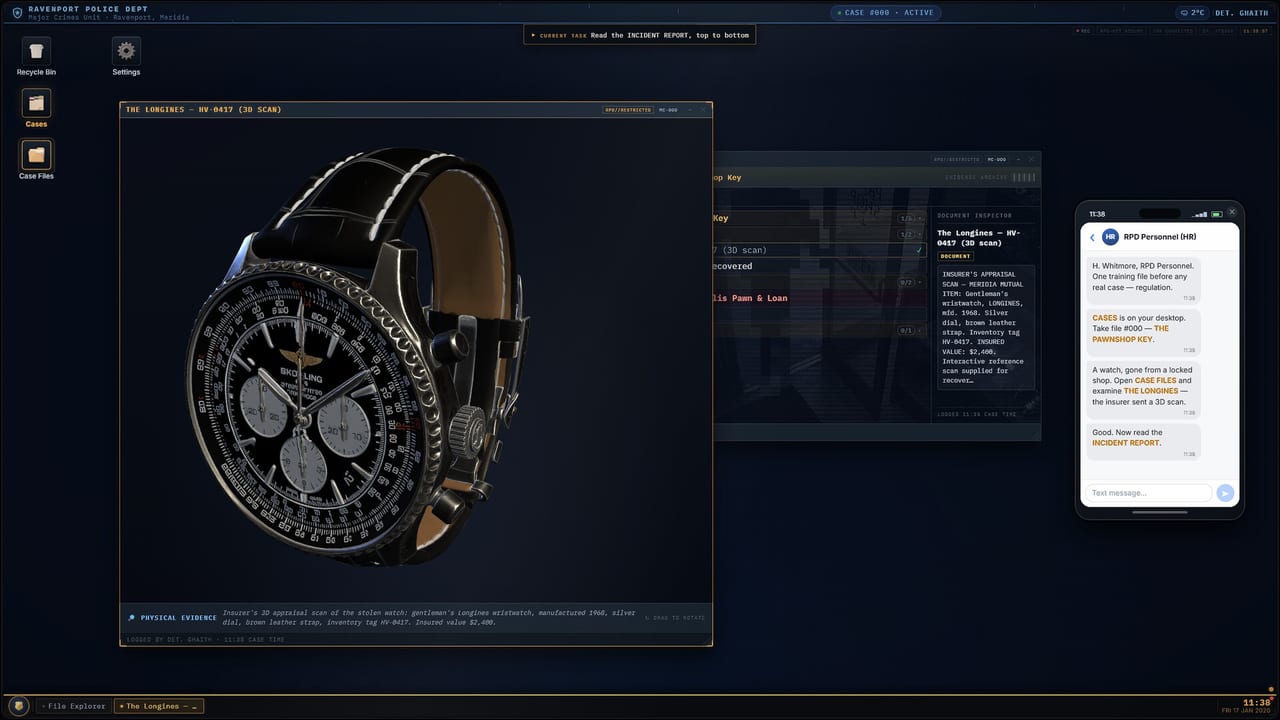
The Forensics Lab in Homicide Desk does not have an Analyze button that fills a progress bar while you make tea. You align the fingerprint. You break the cipher. You calibrate the chromatograph against the clock. Phone records and photos are puzzles you operate. Some documents stay locked or sealed until a code, an interview, or a lab result opens them. Shu’la Lab LLC wants the desk to feel like work. The work is on-screen, mouse in hand, as covered in controls. This page is what those hands are for.
Bring lab output to interrogation and pin it on the evidence board before you file an arrest warrant. First-hour context is Getting Started. Salary and Certification live on the precinct page. The Guides Hub lists every mechanic article.
Prints, 3D scans, and timed instruments
Open Forensics Lab from the desktop. Case Files feed it objects and packets. A 3D scan is not a screenshot: drag to rotate, wheel to zoom, look for a serial, a scratch, a tag. The training object is the Longines watch HV-0417 from Westgate Pawn & Loan at 44 Corbett Street. Match the physical tag to counter receipt 26-0893 (Friday 10 January 2020, 23:40, $650 cash, insured $2,400). If the 3D and the paper disagree, you have a lead. If they agree, you have a presentable document for Tommy Vale.
Fingerprints are alignment puzzles. Drag until ridges seat. A sloppy seat is a failed print, not a “close enough” that the game will auto-correct in court. Chromatograph work is calibration plus a timer. You are matching peaks, not clicking a lore tooltip. Fail the clock and you rerun; you do not get a skip. That timer is why you should not open the lab with an AGITATED suspect waiting and no salary for Offer a Break — finish the instrument, then sit them down.
Ciphers sit on locked packets and on some photos. Master Cryptographer is the achievement for people who actually break them instead of hoping interrogation hands over the passphrase. Request Dossier can buy a packet you already could have decoded. Spend the salary if the clock on the case is social (pressure Email from Morrison). Spend the brain if the lock is a cipher. Leave No Stone and Inspector’s Eye both care that you opened the thing, not that you guessed.
Read Text on documents after they unseal. Nested folders in Case Files hide medical findings, scene reports, and statements that describe violence without turning the game into a gore gallery. The pawnshop file is dry paper. Case #001 The Overtime is not: Marcus Reeves, 41, Principal Engineer at Vanta Systems HQ in Eastdock, found in Server Room B at 21:47 on 17 March 2024, single blow to the head, no forced entry. You will get forensic and medical language. You will not get a glowing outline of the killer.
Photos, UV, phone records, sealed files
Photo analysis is timestamp, crop, and UV. Right-click the desktop for the lamp, then drag it across the print. Residue, annotations, and hidden marks show under UV; a clean photo under white light can still be dirty under the lamp. Do not UV every screenshot you find in Recycle Bin for fun — start with scene photos and anything the file implies was handled. Phone records are flag-the-call work. Mark the time. Cross-reference who dialed whom against City Atlas districts such as Eastdock and Westgate. A call log is evidence only after you write what it contradicts.
Sealed and locked documents are gates. The voicemail about proof in Marcus Reeves’s box points at a strongbox that stays sealed until you earn the open. This guide will not list the earn condition as a spoiler. It will tell you the pattern: lab result, cipher, or a present in interrogation that makes someone give you the code. Presenting a still-sealed file in the booth is pushing with nothing and can lawyer them up. Notebook the code when you get it. The OS will not tattoo it on the taskbar.
Gazette chatter is not a lab result. Personnel File is not a chromatograph. Keep the apps in their lanes so you do not “analyze” a newspaper.
From the bench to the board
Every successful lab action should become a pin. String the print to the person, the chromatograph to the scene, the UV mark to the photo, the call to the clock. The case-chain tracker wants sequence. How to solve a case is the full order: read, lab, board, interrogate, write a deduction, charge. Skipping the lab to rush Swift Justice is how Internal Affairs gets a file with your name on it. Flawless Record wants the science to match the warrant.
Cases 001–003 at launch all expect you to operate the bench. Multiple guilty-party variants mean a reopen can change the truth; your old chromatograph print does not become false, but the story you hung on it might. Re-run UV on photos you filed too early. Re-read sealed packets after an interview. The model in the booth cannot see a peak you never calibrated.
If an instrument hangs after a hotfix, check patch notes. Specs sit on system requirements. Official channels sit on links.
The lab does not love you. It loves alignment, calibration, and a timestamp you can defend in the next interview.
Frequently Asked Questions
Quick answers for detectives still on the clock.
Is there an Analyze button?
No. You align fingerprints, break ciphers, and calibrate the chromatograph yourself, often on a timer. Controls cover drag, zoom, and UV.
How does UV light work on photos?
Right-click the desktop, then drag the lamp across the print. Hidden marks show under UV. Bring anything you find into interrogation as a present, not as a theory.
Why are some documents sealed?
You have not earned the code or the unseal yet — usually a cipher, a lab result, or a booth present. The strongbox tied to Marcus Reeves's voicemail is the homicide example; this page will not spoil the open.
What is Master Cryptographer?
A Steam achievement for cipher work in the lab. Do not skip puzzles by buying Request Dossier every time; salary is for interrogation emergencies.
Should I lab before I interrogate?
Yes, when the object is in hand. Presenting unexamined paper is how people lawyer up. Follow how to solve a case for the full order.
Does forensics tell me who to charge in Case #001?
It gives you timestamps, prints, and unsealed files. It does not name the killer. Charging is a written deduction in the Arrest Warrant app.