Homicide Desk Interrogation Guide
Free-text questions, evidence on the table, stress, and the cost of a break.
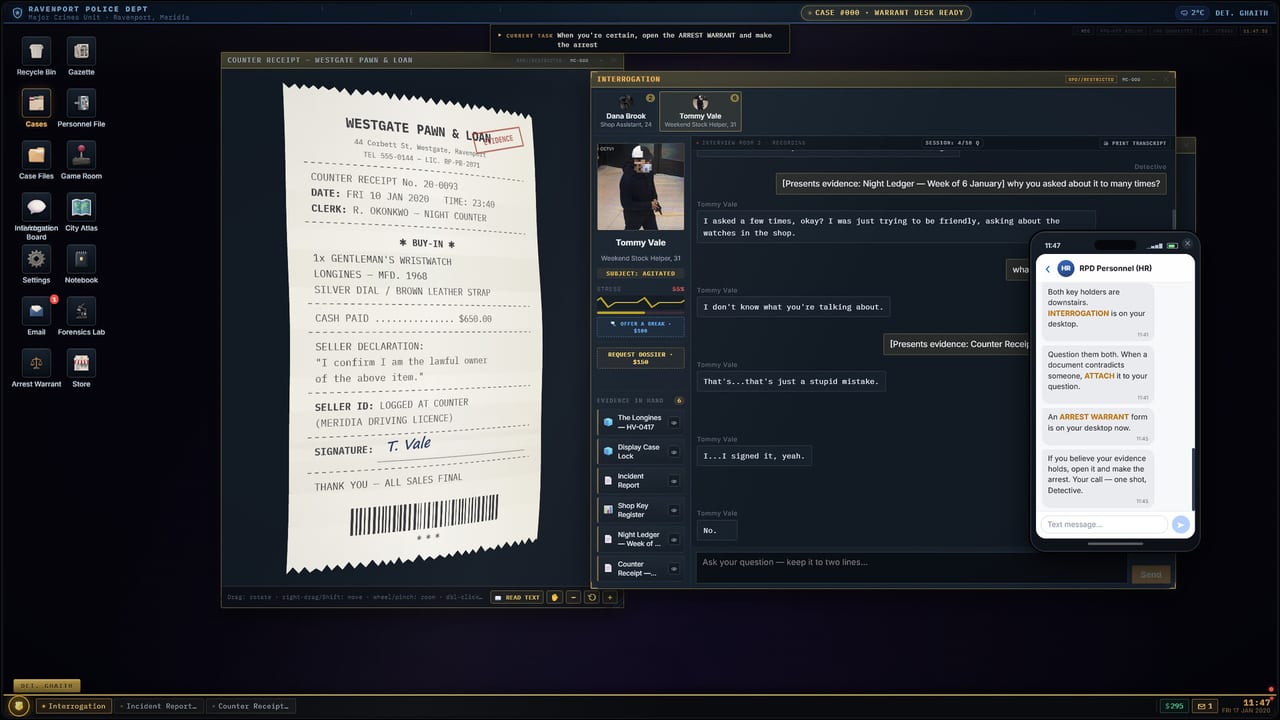
There is no dialogue tree in Homicide Desk. You do not pick Good Cop, Bad Cop, or a numbered lie. You type. The person across the table answers in natural language: deflecting, rationalizing, contradicting a timestamp you already have in Case Files. Shu’la Lab LLC uses a local language model for one job only — phrasing those live replies from what you ask and what you present, constrained to handwritten case facts. Nothing you type leaves the PC. Cases, evidence, and endings stay authored. If the model will not start, that is a system requirements or patch notes problem, not a writing problem.
This page is how to sit someone down without wasting the interview. First boot and Case #000 sit in Getting Started. Mouse and UV sit in controls. Lab work that produces the paper you slide across the table sits in forensics. Salary that pays for a break sits in the precinct guide. The rest of the Guides Hub is linked from there.
How to ask, how to present
Keep questions to two lines. The UI is built for short asks. “Where were you at 23:40 on 10 January 2020?” beats a paragraph about your theory of the pawnshop. Name the fact you want. Ask Dana Brook about closing procedure at Westgate Pawn & Loan, 44 Corbett Street. Ask Tommy Vale about counter receipt 26-0893 and the $650 cash against a Longines watch insured at $2,400. Ask Edwin Hollis about who had after-hours access. Do not ask the model to solve the case for you; it will stay in character and waste your stress window.
Present evidence with the present action, not by typing the filename as a spell. Slide the receipt. Slide a photo. Slide a phone log you flagged in the lab. Watch the stress meter. A real document spikes it. A bluff does not. Push on a spike. If the meter is flat and you keep accusing, they lawyer up and walk. That is the game telling you that you had nothing. On the training robbery you can recover. On Case #001 The Overtime, a lawyered-up engineer or sister can strand a sealed strongbox you have not earned.
Suspects can show AGITATED. That is not a QTE. It is a warning that the next empty shove ends the conversation. Offer a Break costs salary and cools the room. Request Dossier costs salary and pulls paper you could have found in Personnel File or Case Files if you had looked. Both buttons are precinct money. A detective who blew the paycheck on Game Room blackjack cannot buy the pause. Plan spends on the precinct page before you open the booth.
Keep your own Notebook. The model will not remember a theory you never pinned on the evidence board. String the answer to the object before you ask the next person the same question and hope they collide.
Stress, lawyers, and paid tools
Stress is a meter, not a health bar. You want it high for the person who is lying about a timestamp, not for the witness who already gave you the layout of Server Room B. Marcus Reeves was found at 21:47 on 17 March 2024 with a single blow to the head and no forced entry. Sister Dana Reeves will talk. Other names will talk. This guide will not tell you who to break. It will tell you to present the voicemail about proof in his box only after you understand what the sealed strongbox still hides. Presenting a sealed file you cannot open is pushing with nothing.
Offer a Break is for AGITATED. It is not a skip. You are buying time with pay. Request Dossier is for when you walked in under-read. It is cheaper, in time, to read Case Files and run forensics before the interview than to buy the packet mid-room. The interrogation planner exists so you write the two-line asks in advance: time, access, object, contradiction. Then you present. Then you stop.
Wrong tone is survivable. Wrong evidence is not. Internal Affairs does not open because you were rude. It opens because you filed an arrest warrant on a story the lab cannot back. Written deductions in how to solve a case are the bridge between a good interview and a charge that sticks. Multiple guilty-party variants mean a closed file can still change if you reopen it. Do not treat a confession you bullied out of an empty meter as a variant you “unlocked.” That is a lawyer-up you talked past in your own head.
What the AI is allowed to do
Live suspect and witness replies only. Length-limited, in-character, filtered, text. It will not invent a new killer. It will not open a sealed document because you asked nicely. It will not replace Captain Morrison, Whitmore, or the Gazette. If a reply feels off after a patch, check updates — launch week already chased model-server hangs — then ask a cleaner two-line question. Inspector’s Eye and Swift Justice care about what you presented and how fast you closed, not about tricking the model into a soliloquy.
Use controls if you cannot find the present button. Use Getting Started if you have not certified on Tommy Vale yet.
A quiet room and a loud document beat a clever insult. Type less, present more, and leave before they ask for a lawyer.
Frequently Asked Questions
Quick answers for detectives still on the clock.
Is there a dialogue tree?
No. Type free-text questions, keep them to two lines, and use the present action for documents. The interrogation planner helps you prep asks.
What happens if I push with no evidence?
The suspect lawyers up and walks. On Case #000 you can recover. On a homicide, you may lose access you needed for a sealed file. Read how to solve a case before you go back in.
What do Offer a Break and Request Dossier cost?
Salary. Both are paid precinct tools. Bank pay on the precinct page instead of spending it at blackjack before a hard interview.
Does the AI invent case facts?
No. It only phrases replies from handwritten facts plus what you asked and presented. The model runs locally. See system requirements for the 13 GB install.
When should I present the pawnshop receipt?
After Tommy Vale talks around the $650 night sale. Counter receipt 26-0893 is the training present. Walkthrough of that file is in Getting Started.
Can a good interview replace the lab?
No. Sealed files and UV work still need forensics. Charging still needs a written deduction and the Arrest Warrant app.